


Metals & Alloys
Description
Search alloy compositions by prediction — high-entropy alloys, superalloys and functional metals. MatterSeek predicts properties from composition.
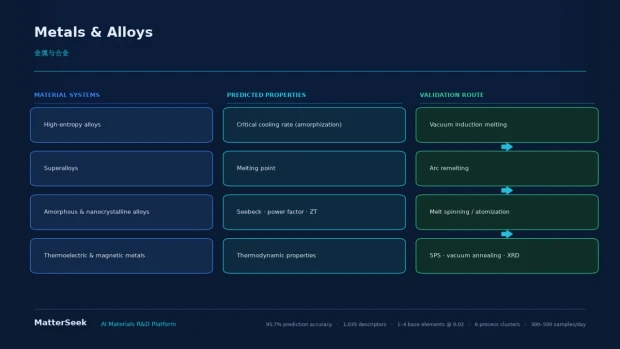
Metals & Alloys — Material System / Predictable Performance / Validation Pathway
AI for Alloy Design — Search High-Entropy and Superalloy Compositions by Prediction
Because it predicts properties directly from composition with one to four base elements at 0.02 doping precision, it is built for the composition-search problem that defines high-entropy alloys, superalloys and functional metals.
A modern multicomponent alloy can be varied across an enormous range of ratios and trace additions, while qualification requires long-duration thermal exposure and mechanical testing. The practical consequence is that development converges on familiar compositions rather than exploring the space systematically.
You describe the base element set and the property window you need — a target melting point, a thermal or thermoelectric requirement, a magnetic or structural objective — and MatterSeek returns ranked candidate compositions with predicted properties and uncertainty. Composition handling covers one to four base elements with doping-level precision of 0.02, matching how alloying and micro-alloying studies are actually specified. Prediction completes in roughly one minute for two base elements, two minutes for three, and seven minutes for four. Results appear as radar charts for multi-property comparison, 2D and 3D heat maps that reveal property gradients across a composition range, and exportable data tables.
The engine covers families including electrochemical, dielectric, thermal, thermodynamic, magnetic, optical and mechanical behaviour — among them dielectric constant, melting point, superconducting critical temperature, Seebeck coefficient, power factor and thermoelectric figure of merit. Results are returned as radar charts for multi-property comparison, 2D and 3D heat maps for composition–property landscapes, and exportable data tables.
The engine covers thermodynamic, thermal, electrochemical and electronic property families, including melting point, critical cooling rate for amorphization, Seebeck coefficient, power factor and thermoelectric figure of merit. Those parameters map directly onto amorphous and nanocrystalline alloy development, thermoelectric materials, and the thermal limits that govern superalloy service.
Predicted compositions move into MatterSeek's 1,200 m² autonomous laboratory, whose first process cluster was built for metals: inert-atmosphere batching, vacuum induction melting, arc remelting, melt spinning or powder atomization, spark plasma sintering, vacuum annealing and machining. Automated characterization includes XRD, XRF and simultaneous thermal analysis. Prediction accuracy is 95.7% against physical measurement, and every measured result feeds the next round. Family coverage includes high-entropy alloys, superalloys, amorphous and nanocrystalline alloys, magnetic materials, thermoelectric materials, lightweight and corrosion-resistant alloys, and powder-metallurgy compositions.
FAQ
Q: Can MatterSeek design high-entropy alloys?
A: Yes. The platform supports one to four base elements with 0.02 doping precision, which is the granularity multicomponent alloy studies require, and returns ranked candidates with predicted properties.
Q: Which alloy properties can be predicted?
A: Thermodynamic, thermal, electrochemical and electronic families, including melting point, critical cooling rate for amorphization, Seebeck coefficient, power factor and thermoelectric figure of merit.
Q: How are candidates validated?
A: Through the autonomous laboratory's metal-route cluster — vacuum induction melting, arc remelting, melt spinning or atomization, spark plasma sintering and vacuum annealing — followed by automated XRD, XRF and thermal analysis.
Yuyao (Beijing) Technology Co., Ltd. is a professional company specializing in the intersection of AI and advanced materials. The company has independently developed MatterSeek—a foundational large model tailored to the materials sector—and pioneered the HNN (Hierarchical Neural Network) algorithm, while building a proprietary, controllable materials experiment database.